Brain-computer interface-augmented police. My thesis explored how people feel about it.
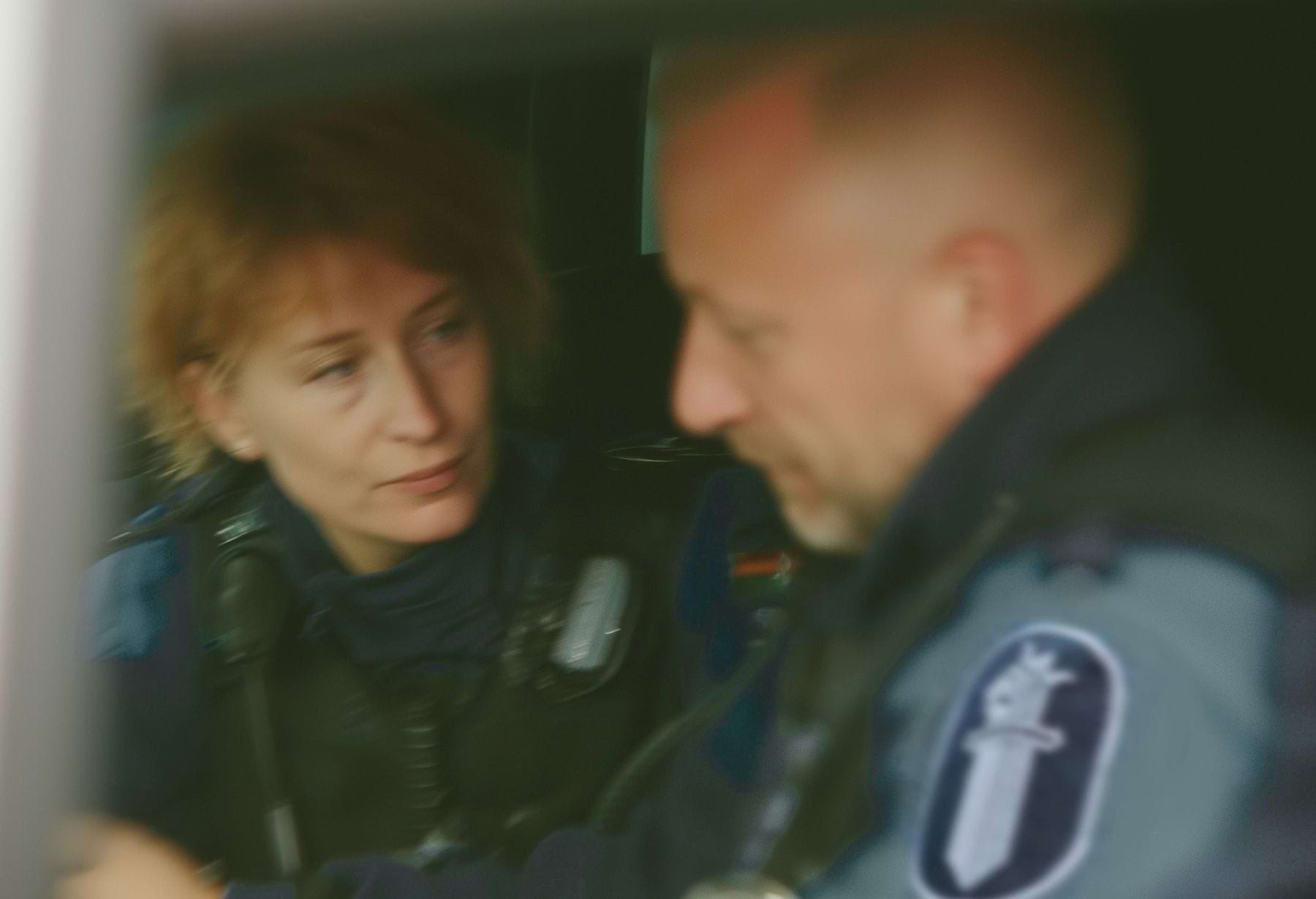
My master's thesis examines how different groups perceive the idea of police officers augmented with brain-computer interfaces. I used design fiction methodology to present speculative BCI scenarios to three participant groups: researchers in a role-play session, a police officer through interviews, and citizens via an online survey.
This post covers three things: what brain-computer interfaces are, how design fiction works as a research method, and why law enforcement is a compelling context for this technology. I'll close with a brief look at what I found. For the full thesis, visit the academic perma-link https://urn.fi/URN:NBN:fi-fe2026031019065. For my thesis defence and the complete design fiction narrative, check out my Human Enhancement With Konstantin Nikkari YouTube channel: https://www.youtube.com/@HEWKN.
Let's start with the technology itself.
Brain-computer interfaces
Brain-computer interfaces (BCIs) are machines that are attached to the human head. Their primary objective is to read human brain waves and translate those wave signals into machine-readable inputs and outputs. For example, a BCI-augmented human looks at their phone and thinks of opening the mail app. The BCI acknowledges this desire and translates it to a command which makes the mail app open. This is absolutely fascinating, as with the help of BCI we can now make and do actions by simply thinking of them. I’d like to make a reference to the science-fiction saga Star Wars, where some characters can, with the use of special energy, manipulate the environment by thoughts and gestures. While we are not yet flying around in the cosmos waving Star Wars lightsabres, we do have this exciting brain-computer interface technology, which lets us take the first step toward manipulating the world with our thoughts. Now, while I connected BCI to something fictional, it is because for decades and probably even longer we have had a passion to not only understand but also read and even write into someone else's cognition. That passion is portrayed in books and films, which brings me to the fiction as a research tool.
Design Fiction
Design fiction is the method I use in my research. The biggest challenge and a gap for my study was—and still is—the possibility to have a brain-computer interface which a law enforcer could strap on at shift start and use as a trusted professional tool. There is no such BCI available. While the BCI technology is advancing from therapeutic applications in controlled environments to real-world deployments, they still are very much in the ‘alpha’ state and far away from being a robust, trustworthy machine, something that should absolutely be the case when talking about law enforcement tools, which must not fail. Because if they do, the life of the officer, the suspect, or bystanders could be in severe danger.
Design fiction serves as a tool to bridge that gap until BCI becomes available. Think of it like this: to understand how a person perceives a police officer using BCI, I can show this person an officer who is wearing BCI and doing actions with it, or I can make the person imagine a police officer wearing BCI and doing actions. Making you imagine something is where the design fiction methodology shines! Design fiction takes various forms: films, short stories, fictional product manuals, physical prototypes, and enacted scenarios. At its best it creates a product that is strong in provocation and rich in story. A good example is my design fiction product of a BCI-augmented officer (https://www.youtube.com/watch?v=w1qHLzkjHOM&t), which manifests as a narrative scenario. That story engages your emotions, requires you to reflect on your life experience and urges you to explain why the story feels ethically wrong.
What design fiction does is a common strategy to get a person to talk. A strategy that undercover field officers have used for decades to extract information from a target. Here is an example: an intelligence agency officer sits with an ‘enemy’ submarine sailor in a bar. The officer says to the sailor: “What I know is that your submarines have technology capable of submerging the marine till 30 metres." The sailor rushes to correct this false claim: “No, absolutely not. 30 metres is wrong! Where did you get this information? Our vessels can often operate under 100 metres because we have an underwater operative station nearby to connect us with surface connections and orientation." Not only did the sailor expose the altitude where they often sail but also the reasons and sources that help them do so. This is what design fiction also does. It creates a product that makes you itch to say, ‘This is wrong, and this is how it should be.’
Before moving to why law enforcement is a plausible BCI user I’d like to make important note to the spy – design fiction analogue. Both do play on the human’s will to correct something which does not feel right and provide methods for how they would do the correction. The spy’s motives for achieving this are often to gain an advantage over the enemy. While the design fiction designers' motives are to produce a user-friendly design and protection from unethical products.
Augmented law enforcement
Law enforcement represents a plausible early-adoption context, as when augmented with BCI, it has specific operational gaps that BCI could fill. I conducted an in-depth interview of a police officer who has over two decades of policing experience and who serves now in a cybercrime unit. And, from my participant population, the police officer was the one who offered articulated, concrete scenarios for why law enforcement is a plausible BCI.
Police departments mandate a lot of technology adoptions, like body cameras, databases, and communication systems, establishing a precedent for required tool use. And while BCI might feel like a scary and distant tool for civilians, the police officers might have much less say about whether they want to use a device that is set to read the brain or not. Especially if this device has proved to bring organisation-wide benefit and stronger fulfilment of police prime missions, which are safeguarding the legal and social order, protecting the safety of citizens, maintaining public order and security, and preventing, detecting, investigating, and referring crimes for prosecution.
The fundamental promise that brain-computer interfaces create is direct pathways between human thought and digital systems that bypass traditional input devices—keyboards, mice, physical interfaces, buttons, and touchscreens. Right now officers have to physically access databases during encounters, which creates delays in time-critical situations. BCI could provide real-time database access through thoughts. And while the BCI does not have 'eyes', it can be connected to body cameras and so provide real-time situational analysis and subjects' body language reading or face recognition, removing the cognitive lag between encountering a situation and understanding it or remembering information.
A brain-computer interface also promises the possibility to control and monitor the BCI-augmented officer. If we had good monitoring of augmented officers, it would provide better multi-unit operations where BCI enables tighter, faster coordination between the ground force and the team lead. This cuts both ways: just as a commander could coordinate a pack of BCI-augmented officers, an individual officer could equally use neural signals to control a swarm of drones or robotic units, extending their operational reach without verbal commands or manual input. BCI usage also predicts precise stress and awareness level monitoring. Which will help officers to manage their stress and the team lead to make decisions in real time and reorganise the ground forces based on the monitored information. If an officer is not well-rested and in an unbalanced emotional state, they serve a bad purpose for the team goal. Such monitoring would require access to emotional monitoring which ignited the strongest negative reactions among my participants. These are still speculative benefits, but they provoke an image of an interesting future and require more serious research in design and behaviour study before any such BCI practice could gain approval.
My study results (in-brief)
My thesis findings demonstrate design fiction's ability to effectively study a BCI technology which cannot yet be studied empirically. The design fiction narrative elicited strong engagement across all stakeholders, prompting participants to articulate concerns about technological dependency, mental privacy and professional ethics. As I wrote above, the strongest reactions centred on mental privacy violations. One respondent warned that "the mere awareness that someone is monitoring my emotions could have a detrimental effect on my mood and psyche." All participants recognised cognitive liberty violations from my design fiction story intuitively and did not need to be taught about it.
A read-write threshold emerged from the interviews. This was something that the previous identity and mental privacy theories did not explore. Participants drew a line without me prompting them: reading brain activity might be tolerable, but writing to cognition crosses a boundary. As one focus group participant said: "If it had only reading capability, it would be much safer. I would trust that more." Also, all stakeholders predominantly perceived the BCI sceptically, not fully binarily but conditionally. They stated that the BCI should have a turn-off feature, the possibility of individual calibration, transparency in its readings and protection against possible dehumanisation. Survey numbers reflected this: 74.5% rejected mandatory adoption, 86% predicted BCI would be more addictive than current technologies, and 60.5% said they would not feel safer with BCI-equipped police.
An interesting missmatch emerged between insiders and outsiders. Civilians overestimate how much say officers have about tools they use. Focus group participants assumed officers would resist and could simply refuse the mandate BCI usage. But my police interviewee saw it differently. He explained how BCI pilots would likely start in voluntary special units and then become mandatory. He also added that in police organisation dissenting voices get silenced because it is a semi-military culture.
Based on this literature study and results, my thesis contributes to understanding emerging BCI technology perception and offers guidance for designing ethical BCI products for law enforcement.
I will provide more in-depth posts. Please follow this blog and also pay attention to my Human Enhancement With Konstantin Nikkari YouTube channel (https://www.youtube.com/@HEWKN).