People do not reject mind reading outright, they reject losing control of it.

This post is not going to be a visual artefact but rather a bang, bang, bang of bullet points on what my study results are, combined with discussion and then thoughts (marked: My own thinking) that merged after some months of cooking in my mind.
Watch this blog post: https://youtu.be/lKrc7CSCB4E?si=8kIwRJxzN3jGE-Gc
Simply put, I studied how people think and how they react to police officers who are using brain-computer interfaces. The official title for my study is the following:
The augmented police officer: A design fiction study of perceptions of brain-computer interface use in law enforcement.
The full thesis is on https://urn.fi/URN:NBN:fi-fe2026031019065. As of today (27.9.2026 updated) my thesis has been downloaded over 350 times, which I think is a fine number for a master's thesis. That many downloads for a master's thesis in 3 months is good. Most theses get read by the supervisors and nobody else. The BCI-policing angle clearly has enough pull to travel beyond the university library crowd.
BCI = Brain-Computer Interface.
The Augmented Police Officer: Study Results & Discussion
Konstantin Nikkari | Master's Thesis | University of Lapland | Grade 5/5
YouTube: https://www.youtube.com/@HEWKN
Study setup
Three participant groups responded to a six-episode design fiction narrative about a Finnish patrol officer in a mandatory BCI pilot.
Focus group: 4 postgraduate researchers (they role-played being a police officer)
Expert interview: 1 police officer, 20+ years' experience, cybercrime unit
Online survey: 43 European citizens via Prolific
* the six-episode narrative is performed in this video: https://www.youtube.com/watch?v=w1qHLzkjHOM&t
Finding 1: The read–write threshold
Participants drew a hard ethical line nobody told them to draw.
- Passive monitoring (stress, attention, recall support) is tolerable. While active cognitive intervention such as writing to cognition, altering decisions is categorically rejected.
- 74.5% rejected mandatory adoption.
- The read-write threshold emerged unprompted in focus group.
- Prior theory described intrusion as a gradient. Participants treated it as a cliff.
- Reading brain activity is acceptable if there is clear benefit, such as alertness management.
Finding 2: Insider–Outsider perception gap
Civilians assumed officers would resist. The officer knew better.
- Focus group and survey participants proposed open dissent or resignation as a response to mandatory BCI use.
- The police professional described a semi-military culture in police organisation where dissent is silenced.
- BCI adoption would likely start voluntary in special units like KARHU, Finland's elite tactical police unit. Then become mandatory through the rest of institution.
- Refusal is not always economically or professionally viable, as often money talks and people can not switch because they have mortgage and family responsibilities.
- Police organisations are vulnerable to forced pilots that citizens would find untrustworthy.
Finding 3: Cognitive dependency and NPC-ification
86% predicted BCI would be more addictive than current AI tools.
- Participants feared losing baseline competence if the BCI device will be used for too long.
- Focus group coined 'NPC-ification': optimised human but emotionally hollowed out.
- Dependency framed not as functional reliance but as gradual loss of moral judgment and autonomous thinking.
My own thinkingBCI could level out personality spikes in thinking. Employers could use this to strip individuality from workers. This is both a risk and a potential benefit.My own thinkingPeople will need to learn to protect their thoughts from a thought-reader. The skull used to be the shield. In the BCI era, a cognitive shield must be consciously constructed. We must learn to keep some thoughts where machine can read them and some where it can not.
Finding 4: Mental privacy and public trust
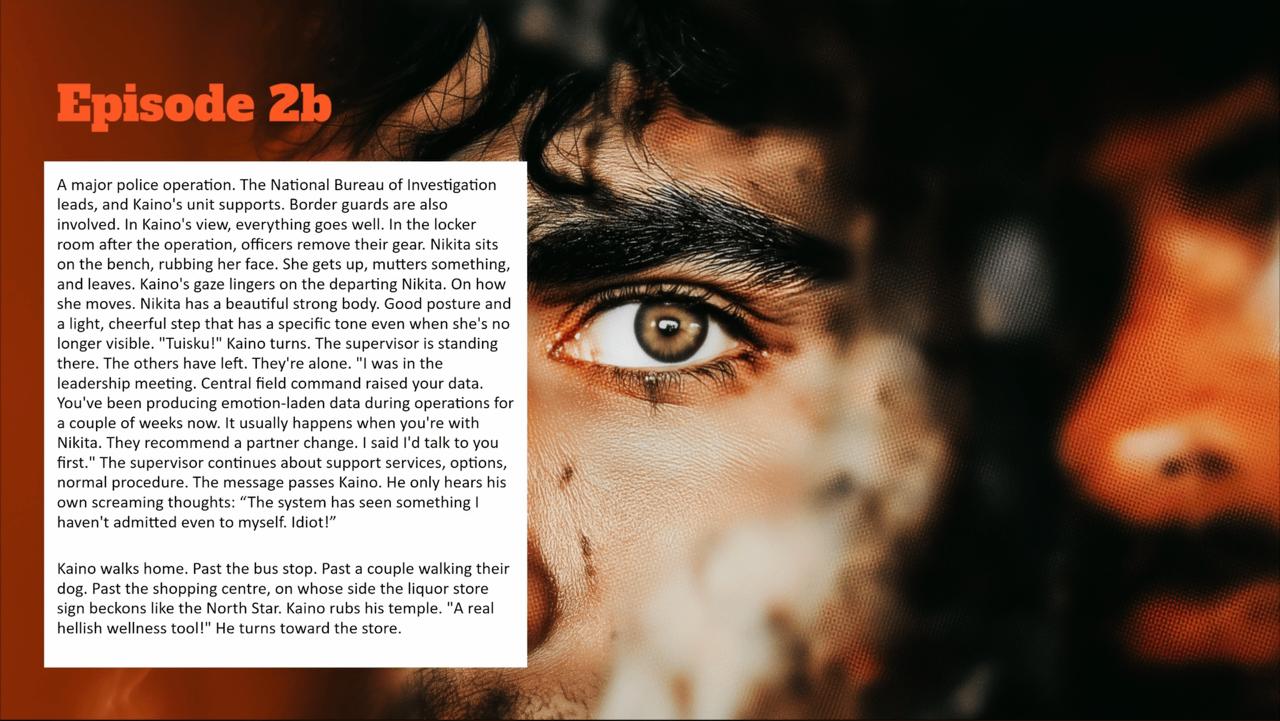
The strongest negative reactions came from emotional monitoring narrative where the machine had interpreted the officer's feelings toward his partner and exposed that data to the police monitor centre.
- 60.5% would feel less safe interacting with a BCI-equipped officer.
- Emotion data collection seen as the deepest privacy violation.
My own thinkingThis is interesting finding. We use emotions to guide our decisions. But, sometimes we like to say that we do not listen emotions and do rational decisions. But then here in my research, if someone gets hold of our emotions and monitors them, then that is the highest privacy violation.- Participants linked reduced empathy in officers to reduced legitimacy of the encounter. But, in the interview, the expert officer provided a talk that BCI could even out police service when some officers are highly empathetic and some have none of that ability.
- One survey respondent warned that awareness of being emotionally monitored would itself damage their mental state. And as in design conditions which participants proposed that they might get stressed simply of knowing that someone is looking at their stress levels.
- Psychological fear that BCI leads to real-world Minority Report (Spielberg) and 1984 (Orwell) scenarios. People resist this.
My own thinkingThis is a critical adoption barrier for BCI developers to solve before any mass usage of BCI is possible
Discussion
What design fiction proved it can do:
- Surface ethical reasoning without academic priming. I build my design fiction based on academical theories but I did not prime to think my participants about those theories. And without prompting they connected their reasoning to those theories.
- Produce corrective responses: participants did not just react, they expressed emotions and solutions of how the BCI adaptation and BCI design should be done.
- Reveal latent institutional dynamics (insider compliance pressure).
- Make abstract cognitive rights theories concrete. Participants expressed the similar concerns as in the theory without knowing the theory.
- The Hero's Journey structure worked well. The very same structure is used to build tens of thousands of films and stories. Narrative arc produced emotional engagement. Rare academic research that participants actually enjoy doing as normally academic research is dry as the Colorado River delta.
BCI and service quality
BCI could equalise service provision. Personality spikes that cause inconsistent policing in customer service could be flagged by the BCI and self-regulated by the user. However, employers could exploit this same mechanism to dehumanise workers into consistent, personality-stripped agents. This is something what participants mentioned about 'NPC-ification'. This tension deserve attention and more study.
Rather than rejecting BCI outright, participants named the conditions under which it would become acceptable:
- Physical off-switch under user control.
- Individual calibration to account for cognitive variation because some people's natural stress levels can be higher than in others.
- Periodic non-augmented operation to maintain baseline competence.
- Voluntary adoption, at least at the individual level.
One-line summary of all of what is here above ☝🏻:
People do not reject BCI outright — they reject losing control of it.
Full thesis: https://urn.fi/URN:NBN:fi-fe2026031019065
YouTube: https://www.youtube.com/@HEWKN